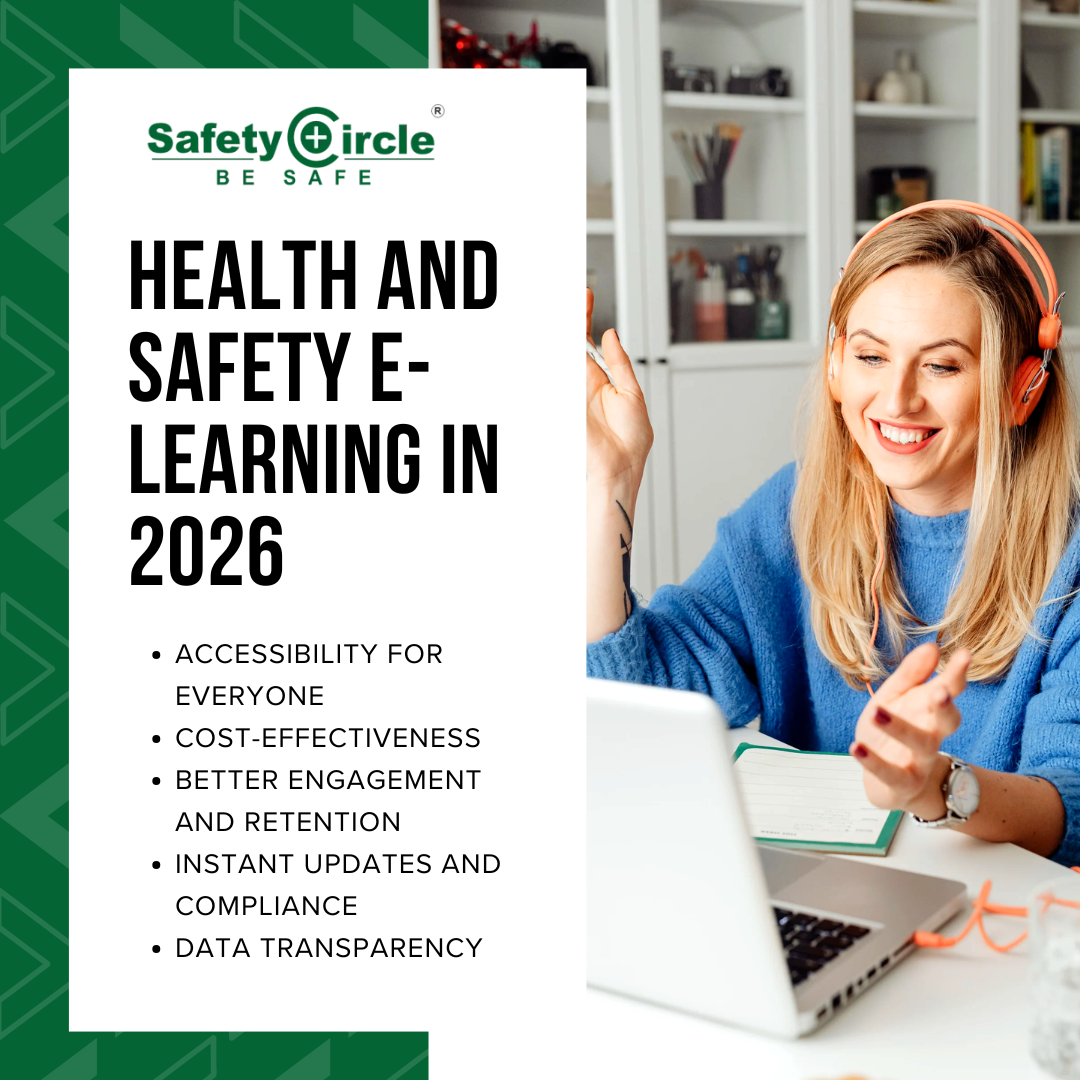
From people returning to work in 2026 to the constantly changing nature of workplaces, one thing remains: the need for effective health and safety training. But organisations are fundamentally educating their employees differently now. Organisations are switching to e-learning solutions for health and safety that make compliance, engagement, and retention simpler than ever.
With access to digital tools, employees can learn at their own pace, and companies can save time, reduce training costs, and improve outcomes. If you have not yet switched to e-learning health and safety training, you may be missing out on some great benefits.
Let us understand why online health and safety programs at this time and phase have become a necessity.
The Future Is Digital: Why E-Learning Dominates in 2026
It took time for this transition to online health and safety training. The proliferation of digital learning was contributed to by hybrid policies that emerged in the post-pandemic workplace and by the ever-increasing automation of compliance.
And by 2026, organisations will seek flexibility and data-backed insights across every part of their operations, including training. Today, e-learning platforms use AI personalisation, video simulations, and gamification to make the information learned more engaging and less boring to pursue.
Such an approach enhances audit preparedness and fosters a culture that prioritises safety.
Benefits of Health and Safety E-Learning
If you are still on the fence about embracing health and safety e-learning solutions, here are three compelling benefits:
- Accessibility for Everyone
Online modules allow employees to learn from anywhere, on any device. Irrespective of whether it is remote or operating in a multi-site environment, uniform compliance with safety standards is ensured.
- Cost-Effectiveness
Instructor-led training in a traditional classroom setting often involves scheduling challenges and instructor costs. By eliminating these overheads, e-learning reduces costs while providing scalable learning to hundreds of employees.
- Better Engagement and Retention
E-learning health and safety training can often be a dry, tedious process, with instructional videos that can make the experience painfully dull. And when employees find the experience enjoyable, they tend to retain vital safety information.
- Instant Updates and Compliance
Regulations evolve quickly. Writing and updating a digital course takes a fraction of the time it would take to reprint training manuals. Helps businesses stay compliant with minimal disruption.
- Data Transparency
HR gets real-time data on the number of people who have completed the modules, the associated assessment scores, and growth metrics. It provides the necessary insights for audits and continuous process improvement.

The Role of Technology in E-Learning Health and Safety
Digital infrastructure is the backbone of the modern workplace — and modern learning, too. E-learning health and safety training experiences have been transformed thanks to AI-powered learning paths, a mobile-first training app, and VR simulations.
Warehouse staff, for example, can do training in real-world virtual environments with real threats. Health care workers practice realistic safety drills electronically before working on site. Interactive 3D modules allow construction teams to revisit hazard-identification exercises.
With this digital transformation, employees are empowered to respond correctly in high-risk scenarios, closing the gap between theory and practice.
Why Businesses Need a Safety-First Mindset
Not only does quality online health and safety training meet compliance standards, but it also alters workplace culture. Staff laugh and understand safety best practices, increasing the sense of confidence, engagement, and value.
In addition, safe workplaces incur fewer accidents, reduced downtime, and potentially increased morale. Trends in global safety over the past few years have shown that retention rates and practical application are up to 40% higher when using an e-learning model compared to traditional training methods.
Integrating E-Learning with Onsite Training
In this age of technology, physical training sessions cannot be replaced. Integrating e-learning health and safety with physical drills forms a balanced hybrid training model.
Employees, for example, can attend online theory sessions and then carry out supervised practical activities to apply their learning. It integrates safety learning into new thoughts and behaviours.
If your organisation is already partnered with a health and safety training provider, incorporating an e-learning component will further enhance the training’s impact.
The ROI of E-Learning Health and Safety
Let us get to what every organisation wants to know — ROI. A shift to digital training can reduce learning expenses by 60% and downtime by up to 40%. It also reduces onboarding time for new hires, allowing them to be productive and in compliance sooner.
This would justify the investment all by itself, but the fact that compliance tracking, injury prevention, and employee confidence improve in measurable terms is just icing on the cake. In addition, e-learning health and safety training promotes sustainability by significantly reducing the use of printed materials.
In other words, it’s beneficial for your people, your profits, and the planet.
FAQs About Health and Safety E-Learning
1. What is e-learning in relation to health and safety?
Online workplace safety training is a digital approach to educating employees about workplace safety standards, risk management, and compliance obligations through web-based platforms.
2. Is e-learning able to take the place of traditional safety classrooms?
Not quite, but it definitely goes well with them. The theoretical component of the learning needs is well addressed through e-learning, while physical sessions help embed the practical aspects.
3. Is Online Health and Safety Training Right for All Industries?
Absolutely. E-learning can be related to the e-structure of an organisation: From manufacturing, construction, to office-based teams.
4. How long does typical e-learning health and safety training take?
Course duration varies. Some introductory modules could take 30 minutes, whereas some deep-dive compliance tracks could take hours.
5. What should I look for in a training provider?
Choose a partner that provides certified, customisable content and in-house support. Both government and private entities have set safety standards and other business operations, so a professional health and safety training company will also ensure you comply with local regulatory standards.
Final Thoughts
As we move into 2026, shifting safety training to a virtual environment is not just a consideration; it is an operational requirement. Health and Safety eLearning enables organisations to deliver training more quickly, provides better tracking capabilities, and leads to safer workplaces.
Creating innovative, simple, and data-oriented online training models strengthens the most important resource for any business: its people.
Safety Circle, the top health and safety training company, continues to lead by example in innovative safety training services by fusing the digital learning experience with industry experts to help make workplaces in every corner of the world safer for the companies that seek their guidance.