All drivers agree on one point: safety on the road is paramount. Traditional driving lessons are great for the basics, learning how to start, stop, and park. Still, nothing compares to the adrenaline-fueled panic of having to react in an emergency, something no textbook or instructor in the front seat can replicate.
This is where a Simulator-Based Defensive Driving Training can be considered a progress-oriented innovation, closer to our everyday lives in terms of programming-driven driving, particularly for novices, bridging the gap between learning and genuine driving knowledge. Let’s explore how it works and why it’s quickly becoming a pillar of safer driving programs from one side of the planet to the other.
What Is Simulator-Based Defensive Driving Training?
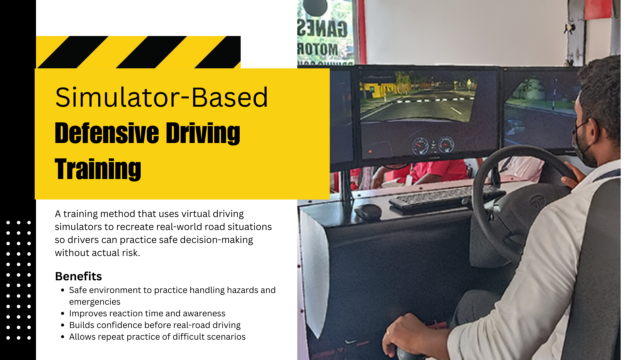
An online driving training simulator uses modern virtual technology to mimic real-world driving scenarios. It helps you drive on the digital road, where conditions are unpredictable and risky, similar to a real road without the risk of harm.
Advanced training driving simulators nowadays comprise life-like 3D images, motion response, and environmental conditions such as rain, mist , and driving in the dark. This trains drivers to anticipate dangers and make rapid decisions under stress.
Unlike lessons based on theory, simulators establish engaging experiences with consequences where learners can:
- React to emergency braking situations.
- Practice collision avoidance.
- Navigate through construction zones.
Such an approach transforms “learning in a classroom” into “learning from an experience,” and this is the essence of defensive driving training.
The Science Behind Simulator-Based Learning
The human brain learns reflexes, and when a driving simulator presents different traffic scenarios, it prepares your brain to respond correctly. You know how to discern patterns, avoiding the panic response that only leads you to react when it is an accident, instead of finding yourself in harm’s way.
Advantages of simulator-based learning include:
- Unlimited practice without risk: Drivers can practice hundreds of scenarios.
- Real-time Feedback: Errors trigger visual or auditory notifications instantly.
- Less sympathetic response to actual danger: One is less inclined to be scared when in real danger, as they are used to it.
Why Defensive Driving Matters More Than Ever
Defensive driving is more about anticipation, awareness, and precision. It’s about staying mindful and in power when everyone else is out of it.
In a defensive driving course, you will learn about safe following distance, different scanning techniques, braking strategies, and controlling speed. This knowledge becomes instinct once you put it through a driving training simulator.
For example, a learner might be in a simulator scenario in which another vehicle slams on the brakes. It’s the ideal course to stimulate the driver’s reflexes so they hurry there in real life—while avoiding real-world peril.
How Simulator-Based Courses Transform Learner Outcomes
Climate within those environments, such as road rage, black ice, or mechanical failure, is often challenging to replicate as desirable learning. A simulator removes these limitations.
Key transformations include:
- Better judgment in critical moments: Simulation-trained drivers are more likely to respond rationally to unexpected events on the road.
- Safer driving habits: According to the data, those trained with simulators tend to break the rules less often and have fewer post-training infringements or accidents.
- Confidence without overconfidence: Practice, however, is a sweetener of assurance for learners, not wildness.
- Efficiency in learning: Through online tools, refresher courses are offered remotely, such as via an online driving training simulator.
Simulators boil down to making mistakes in a safe place so you don’t repeat them in less secure environments (outside a simulator).
Online Driving Simulators: The Future of Driver Safety
As digital transformation continues to change the face of learning, the online driving training simulator heralds a new era. They blend the accurate 3D driving simulation with the convenience of eLearning platforms.
Modules like city traffic, highway, or night driving can be accessed by learners from anywhere, anytime. The more sophisticated car-driving training simulator even has artificial intelligence (AI) to provide performance reviews and individualised feedback after every session.
This flexibility transforms safety education into a scalable, contemporary solution for organisations investing in remote employee training and for individuals preparing for license upgrades.
Comparing Simulator-Based and Traditional Training
Let’s compare how simulator training stacks up against conventional driving lessons:
| Feature | Traditional Driving Lessons | Simulator-Based Training |
| Real-Road Risk | High | Zero |
| Scenario Variety | Limited | Extensive |
| Cost Efficiency | Moderate | High (long-term) |
| Feedback Quality | Instructor-based | Data-driven + Instant |
| Accessibility | In-person only | Online + In-person |
How to Get the Most Out of Simulator-Based Defensive Driving
As with any instrument, the maximum ease is achieved when it is used correctly. To maximise learning:
- In addition to simulation, take a defensive driving course.
- Book refresher courses to keep up with changing traffic laws.
- Know about areas of improvement by reviewing a simulation data report
- Interact with professional trainers from a safety training company focused on correcting unsafe behaviour on the road.
With this holistic approach, simulator training becomes not a once-off exercise but a cycle of ongoing enhancements to safety behaviours.
FAQ
Q1. Is this simulator training really as good as driving?
Yes. Though it doesn’t give the actual feel of driving in outdoor traffic, it certainly does make you feel more ready , as it provides the high-pressure situations that real instruction can’t safely simulate.
Q2. Is it a good idea for beginners to start with a driving simulator?
Absolutely. If you want to develop some skills before getting behind the wheel and making a mistake, lowering the setting in the driving zone, the driving training simulator is an excellent start for any beginner.
Q3. Online driving course or simulator — what is the difference?
A course offered online on traffic laws and safety concepts. But an online driving training simulator lets you practice those lessons virtually, helping you remember how to react and develop quick reflexes.
Q4. How does simulator-based training complement the safety of fleet drivers?
Fleets use simulators to enhance defensive driving training, monitor driver performance, reduce accident rates, and meet safety compliance protocols.
Q5. How do I pick the right simulator provider?
Work with a reputable safety training company that offers realistic simulation modules, performance tracking, and programs tailored to your objectives.
Conclusion
In the face of increasing road risks, a car-driving training simulator can be a lifesaving tool; it is no longer a luxury but a necessity today. This new approach offers tangible, lifesaving enhancements that can scale to the thousands, whether you are a new driver seeking real-world experience in safety or an organisation seeking to optimise fleet performance.
As the leader in proactive and dependable road safety education, Safety Circle is pioneering next-generation defensive driving courses and simulator-based programs that empower people and companies.