Key Takeaways
- Match the right fire extinguisher to the right fire class.
- Learn PASS: the technique every trained employee must know.
- Spot common mistakes before they happen at your workplace.
- Understand what inspections your workplace legally needs.
- Know how to get certified through Safety Circle India.
Objective
A practical India-focused guide on fire-extinguisher training: types, techniques, maintenance, certification, and Safety Circle’s program.
Introduction
Walk into any Indian office or factory and you’ll spot a fire extinguisher on the wall. Most employees walk past it daily without a second look.
Now imagine a small fire breaks out. Someone grabs the nearest one, aims at the flames, and nothing changes. Wrong type. Wrong technique.
That’s why fire extinguisher training matters: it’s the difference between stopping a fire early and watching it spread. Combine it with first aid training, and your team handles what comes after too.
Table of Contents
- Why Fire Extinguisher Course Is Mandatory at Every Workplace
- Types of Fire Extinguishers Used in Indian Workplaces
- Which Fire Extinguisher to Use for Which Class of Fire?
- The PASS Technique: How to Use a Fire Extinguisher Correctly
- Common Mistakes Employees Make During Fire Emergencies
- Fire Extinguisher Maintenance & Inspection Schedule
- Workplace Fire Safety Training: Beyond the Extinguisher
- How to Get Fire Extinguisher Training Certification in India
- Safety Circle’s Fire Equipment Training Program
- FAQs
Why Fire Extinguisher Course Is Mandatory at Every Workplace
Here’s what most employers miss: the legal requirement for basic fire safety training under India’s National Building Code isn’t the scary part. The scary part is when the alarm goes off and nobody knows what to do.
Real benefits of fire safety training that people notice:
- Trained people are 80% less likely to panic when a real emergency hits
- Stopping a fire early protects lives, property, and your business
- Legal liability drops, and so do insurance risks
- Staff feel genuinely safer, not just ticked off a compliance list
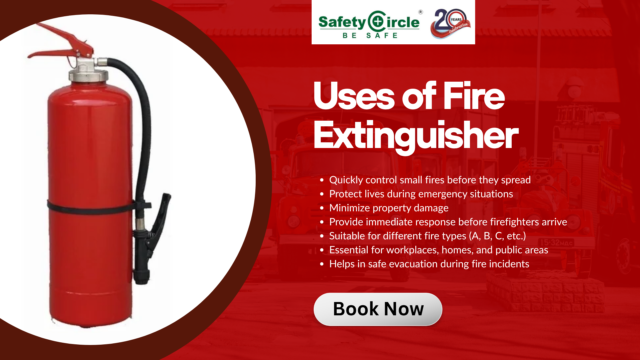
Types of Fire Extinguishers Used in Indian Workplaces
People are often surprised to learn there’s more than one kind. Fire equipment training starts here because picking up the wrong one in a panic can make a fire spread faster, not slower.
- Water: Paper, wood, cloth fires only. Never near electrical equipment
- CO₂: Flammable liquids and electrical fires. Clean, no residue, safe around machines
- Dry Chemical Powder (DCP): The most common in Indian factories and warehouses. Covers Class A, B, and C fires
- Foam: Solid material and flammable liquid fires
- Wet Chemical: Only for cooking oil fires. Restaurants and office kitchens need these specifically
Which Fire Extinguisher to Use for Which Class of Fire?
Memorize this or stick it on your wall. Solid training on fire safety drills this into people until it’s automatic, because during a fire, you won’t have time to read a chart.
| Fire Class | What’s Burning | Right Extinguisher |
| Class A | Wood, paper, cloth, plastic | Water, Foam, DCP |
| Class B | Petrol, paint, solvents | CO₂, Foam, DCP |
| Class C | LPG, CNG and other gases | DCP |
| Class E | Live electrical equipment | CO₂ |
| Class F | Cooking oils and fats | Wet Chemical |
The PASS Technique: How to Use a Fire Extinguisher Correctly
Ask anyone who’s done fire-extinguisher training what they remember most: it’s PASS. Four steps drilled until your hands know them even when your brain is running on adrenaline.
- P: Pull the pin from the handle to arm the extinguisher
- A: Aim low, at the base of the fire, not the visible flames
- S: Squeeze the lever with steady, even pressure
- S: Sweep side to side across the base until the fire is out
One thing people miss: aim at the source, not the smoke. That mistake alone wastes the whole cylinder.
Common Mistakes Employees Make During Fire Emergencies
Most people are confident they’d handle a fire well. Then it happens and they freeze, spray the wrong direction, or block the exit. Fire safety training for employees addresses what actually goes sideways in real incidents.
- Reaching for the nearest extinguisher without checking if it’s the right type
- Spraying at the flames, not the base: the most common and costly error
- Hesitating, hoping someone else will step in first
- Skipping the alarm and going straight for the extinguisher alone
- Standing in front of the exit while trying to manage the fire
- Ignoring smoke because the visible fire seems small
- Not knowing where extinguishers are placed in their own building
Fire Extinguisher Maintenance & Inspection Schedule
An extinguisher that’s never been touched since 2019 isn’t going to save anyone. Part of any good fire safety training program is teaching people what a ready, maintained unit actually looks like and what to do if it isn’t.
- Monthly: Is it still in place? Pressure gauge green? Pin and seal untouched?
- Annual: Certified technician inspects and services every unit
- Periodic: Internal condition and cylinder integrity reviewed professionally
- Log it all: Inspection records are a regulatory requirement in India
Workplace Fire Safety Training: Beyond the Extinguisher
National Fire Service Week 2026 runs April 14 to April 20 in India, rooted in the 1944 Bombay Dock explosion. Every year fire safety week in India asks every organization the same thing: are your people actually ready or just technically compliant?
A solid fire safety week 2026 India workplace plan covers:
- Regular mock evacuation drills. Repetition is what makes it instinct
- Walkthrough sessions where employees spot actual hazards in their own workspace
- Emergency Response Teams trained per shift, not just on paper
- Evacuation maps at eye level on every floor and corridor
- Floor wardens who know exactly who they’re responsible for
How to Get Fire Extinguisher Training Certification in India
You don’t walk in needing anything. Safety Circle’s program is designed so a first-timer and a seasoned safety officer both get real value out of it.
- Theory covering fire classes, extinguisher types, hazard spotting, and what the law actually requires
- Hands-on time with real equipment, not just watching a video
- A practical check to confirm you’ve actually got it
- Certificate once you’re done, with refreshers available every two years or whenever your organization needs it
Safety Circle’s Fire Equipment Training Program
Safety Circle India has been at this for over 20 years. Fortune 500 companies, factories, schools, and hospitals across India trust them. Not because they run a slideshow, but because their fire safety training for employees is built around actual practice.
| What’s Covered | What You Walk Away With |
| Fire-Extinguisher Training | Hands-on PASS practice, type selection, real scenarios |
| Evacuation Drills | Escape route planning, warden roles, assembly points |
| Fire Safety Workshops | Hazard spotting, prevention habits, safe environment setup |
| First Aid and CPR | Post-fire care, burn management, response before help arrives |
| Fire Safety Assessments | On-site hazard review, evacuation route evaluation |
| VR-Based Training | Scenario-driven immersive emergency simulations |
Sessions run 4 to 6 hours. Online and on-site both work. Certificate included; no experience is required to show up.
Get in touch: safetysaves@safetycircleindia.com or +91 7347026829.
Frequently Asked Questions
Q1. Is fire extinguisher training legally required for Indian workplaces?
Yes. Nearly all Indian states require it under the National Building Code and State Fire Safety Acts. Fines and liability are real consequences, but the bigger concern is your team’s safety when a fire breaks out and nobody’s trained.
Q2. How often does fire extinguisher training need to be renewed?
Safety Circle recommends every two years, or whenever your organization requires it sooner. If someone’s been through it before, there’s a refresher format available so you’re not starting from scratch.
Q3. Can the same extinguisher work on every fire?
Definitely not. Water near live electrical equipment can get someone killed. DCP on a cooking oil fire makes it explode outward. Training exists so you know which type to grab without second-guessing.
Q4. What does Safety Circle’s fire extinguisher course actually cover?
Fire prevention, how to identify hazards before they turn into emergencies, the different extinguisher types, the PASS method, how to evacuate a building properly, and basic first aid. No experience needed. Complete beginners do this program every day.